
Modern ion chromatography techniques are evolving to enhance analytical accuracy considerably. By integrating advanced detection methods ion exchange chromatography, such as tandem mass spectrometry and conductivity detection, analysts achieve lower detection limits and better sensitivity for trace ions. Improved separation techniques, including gradient elution and size exclusion chromatography, optimize the resolution of closely eluting ions. These innovations not only streamline workflows but also promise robust applications across various fields, raising questions about future developments in this critical analytical domain.

The Fundamentals of Ion Chromatography
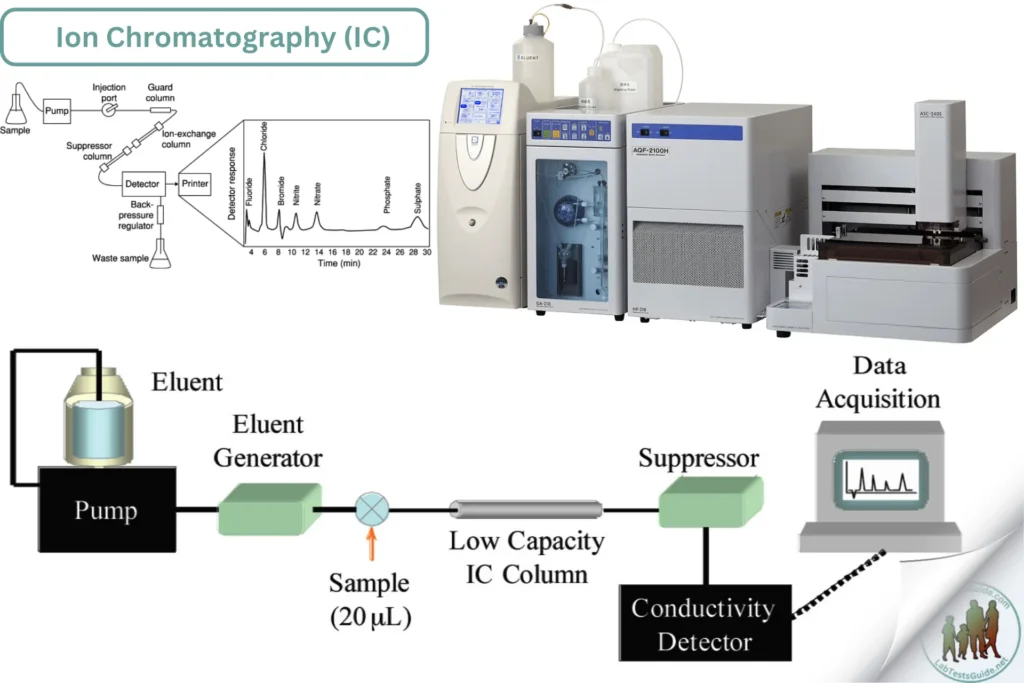
Ion chromatography (IC) serves as an indispensable analytical technique for the separation and quantification of ionic species in various samples.
The core principle of IC is ion exchange, where analytes are separated based on their charge interactions with a stationary phase https://laballiance.com.my/. Sample preparation is a vital step, as it involves the removal of potential interferences and the concentration of target ions. Proper sample handling guarantees accuracy and reproducibility in results.
Typically, samples undergo filtration and dilution to achieve ideal concentrations for analysis. The choice of eluent also plays a significant role in enhancing the selectivity and resolution of the separation process.
Recent Technological Advancements
As advancements in technology continue to evolve, ion chromatography (IC) techniques are increasingly benefiting from innovations that enhance both efficiency and analytical capabilities.
Recent technological advancements have prominently featured automation integration, allowing for streamlined workflows and reduced human error. This integration facilitates high-throughput analyses, enabling laboratories to process larger sample volumes while maintaining accuracy.
Additionally, software innovations have greatly improved data management and analysis, offering sophisticated algorithms for peak identification and quantification. These advancements support real-time monitoring and predictive analytics, enhancing the overall reliability of results.
Consequently, the combination of automation and advanced software tools positions modern ion chromatography as a frontrunner in analytical chemistry, optimizing performance and ensuring compliance with stringent regulatory standards.
Enhanced Detection Methods
While traditional ion chromatography has proven effective for various applications, the integration of enhanced detection methods markedly elevates the analytical capabilities of this technique.
Recent advancements include the use of tandem mass spectrometry and conductivity detection, which provide significant sensitivity improvements. These methods enable the detection of trace levels of ions, consequently achieving lower detection limits than previously possible.
Enhanced detection methods facilitate the analysis of complex matrices, improving the accuracy and reliability of results. Additionally, the combination of advanced detectors with improved data processing algorithms allows for better quantification and reduced background noise.
Improved Separation Techniques
The development of improved separation techniques has notably enhanced the efficacy of ion chromatography in various analytical applications.
Among these advancements, size exclusion chromatography has gained prominence for its ability to separate ions based on their molecular size, facilitating the analysis of complex mixtures. This method minimizes the interactions between analytes and stationary phases, leading to enhanced resolution and faster analysis times.
Additionally, gradient elution techniques have been implemented to optimize the separation process further. By varying the composition of the eluent over time, gradient elution allows for the effective separation of closely eluting ions, improving peak resolution and reducing analysis times.
Together, these modern separation techniques considerably contribute to the accuracy and reliability of ion chromatography results.
Application of Modern Ion Chromatography
Modern ion chromatography has emerged as a pivotal analytical technique across various sectors, including environmental monitoring, pharmaceutical quality control, and food safety testing.
Its high sensitivity and accuracy enable the detection of trace ionic species, which is essential for compliance with regulatory standards.
As industries increasingly prioritize safety and quality, the application of advanced ion chromatography methods becomes indispensable in ensuring product integrity and environmental protection.
Environmental Monitoring Applications
Ion chromatography (IC) serves as a pivotal tool in environmental monitoring, enabling the precise quantification of anions and cations in various matrices. The technique is instrumental in evaluating water quality, providing critical data on pollutants such as nitrates, sulfates, and chlorides.
By employing modern IC methods, researchers can detect low concentrations of these ions, facilitating thorough pollution assessments. Additionally, IC allows for the simultaneous analysis of multiple species, enhancing the efficiency of environmental studies.
The method’s high sensitivity and specificity contribute to its effectiveness in regulatory compliance and environmental protection efforts. Overall, the integration of IC in environmental monitoring supports informed decision-making and the implementation of strategies to mitigate pollution and safeguard water resources.
Pharmaceutical Quality Control
Utilizing ion chromatography for pharmaceutical quality control enhances the reliability of analytical results by enabling the precise separation and quantification of ionic compounds in drug formulations.
This technology plays a critical role in meeting stringent pharmaceutical regulations, ensuring that products adhere to established safety and efficacy standards.
By facilitating the detection of impurities and active ingredients, ion chromatography supports extensive quality assurance processes, which are essential for maintaining product integrity.
The ability to analyze complex matrices with high specificity allows manufacturers to identify potential contaminants and verify compliance with regulatory requirements.
Consequently, modern ion chromatography not only streamlines the quality control workflow but also fosters confidence in the pharmaceutical industry’s commitment to delivering safe and effective medications to consumers.
Food Safety Testing
As food safety concerns intensify globally, the application of advanced chromatography techniques, particularly ion chromatography, has emerged as an essential tool for detecting and quantifying ionic contaminants in food products.
This method excels in identifying various chemical contaminants, including anions and cations, which are pivotal in evaluating food safety. Ion chromatography’s high sensitivity and specificity allow for the detection of trace levels of contaminants, ensuring compliance with stringent safety regulations.
In addition, standardized testing protocols facilitate consistent and reproducible results, critical for regulatory compliance and consumer protection.
Future Trends in Ion Chromatography
Although advancements in analytical chemistry have historically influenced ion chromatography, the future of this technique is poised for transformative growth driven by emerging technologies and methodologies.
Automated systems are expected to enhance throughput and reproducibility, allowing for high-volume analyses with minimal human intervention. Moreover, the integration of data analytics will facilitate real-time monitoring and interpretation of chromatographic results, leading to more informed decision-making processes.
Advanced software platforms will provide seamless data integration, enabling researchers to correlate ion concentration data with other analytical results. Additionally, the development of miniaturized and portable ion chromatography systems will expand applications in field testing.
Collectively, these trends will enhance the robustness and versatility of ion chromatography, positioning it as a critical tool in various analytical domains.
Conclusion
To summarize, the integration of advanced detection methods and improved separation techniques in modern ion chromatography markedly enhances analytical accuracy. By employing tandem mass spectrometry alongside conductivity detection and optimizing separation through gradient elution and size exclusion chromatography, analysts can achieve unparalleled sensitivity and resolution. These innovations not only facilitate precise quantification but also broaden the scope of applications, ensuring reliability in critical fields such as environmental monitoring and food safety. The future of ion chromatography appears promising, driven by ongoing technological advancements.
